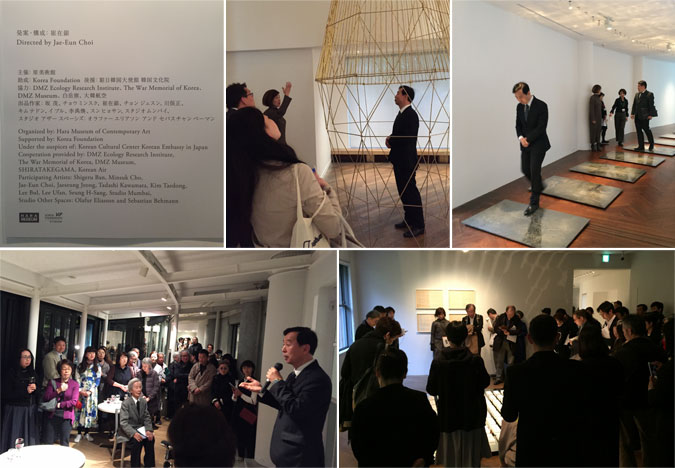
The Korea Foundation rendered its support to an exhibition on the Demilitarized Zone (DMZ) on the Korean peninsula. The exhibition, entitled “The Nature Rules: Dreaming of Earth Project,” is held at the Hara Museum of Contemporary Art in Tokyo from April 13 to July 28, 2019. The ambitious exhibition is based on Korean artist CHOI Jae-eun’s “Dreaming of Earth Project,” first presented at the 2016 Venice Architecture Biennale.
The “Dreaming of Earth Project” started from an idea of maintaining the harmonious coexistence between humanity and the ecosystem of the DMZ. Artist CHOI Jae-eun imagined what it would be like if a wooden walkway of 3 to 6 meters in height were built on the landmine-ridden DMZ, the symbol of the division of Korea, to enable people to freely come and go. Her imagination was materialized at the Venice Architecture Biennale, where she collaborated with Japanese architect Ban Shigeru to install floating garden at a scale of 1/200. The installation was an artistic reinterpretation of the DMZ to send a message of overcoming division and conflict with the power of life, and it resonated among many people.
Ever since, artists, architects and scientists in various sectors from different countries have participated in the project. The Korean participants included installation artist LEE Bul, Prof. JEONG Jaeseung of the Department of Bio and Brain Engineering at KAIST, and architects SEUNG Hyo-sang and CHO Min-suk. They gradually expanded the project by adding a pavilion, a pagoda, a reservoir of life and knowledge, and a plan of demining the area to preserve life and peace in the DMZ.
Later, Hara Museum of Contemporary Art President, HARA Toshio, and the director of the museum, his wife UCHIDA Yoko, took an active interest in the value of the DMZ and the idea of its preservation. Together, they embarked on organizing Japan’s first-ever exhibition on the Korean DMZ. Artists from five countries – Korea, Japan, Germany, Denmark and India – participate in the exhibition in Tokyo, which showcases 20 installation and video works created to preserve the diverse ecosystem of the DMZ.
Although, while organizing the exhibition, some hurdles had to be overcome due to setbacks in diplomatic relations between Korea and Japan, the exhibition was eventually realized with support from the Korea Foundation, impressed by the desire to create an international consensus on the DMZ and lasting peace.